He Priced It at $349 a Year for $75,000 of Coverage. That Plan Caps a Single Camera at $2,000.

Rob Ainscough opened a thread on the DPReview forums in April with a question about leaving a camera alone for a few hours, and ended up doing the most useful thing anyone in that thread did: he actually priced a policy and then read the terms. What he posted back is a small masterclass in why camera insurance is hard to shop for.
"So I looked at Full Frame (fullframeinsurance.com) which seems reasonable price ($349/yr for 75K coverage) ... EDIT: more research on Full Frame insurance, they have some pretty big 'limitations' 1. will not cover equipment left in car unattended 2. will only cover depreciated value of which they deem based on their schedule (inquired and my Sony A1 II that I got a few months ago would only get about $2150 back)"
He blamed the $2,150 on depreciation. Full Frame's own published pricing suggests something else may be doing the work, and the two are almost impossible to tell apart from where he was standing.
The short version:
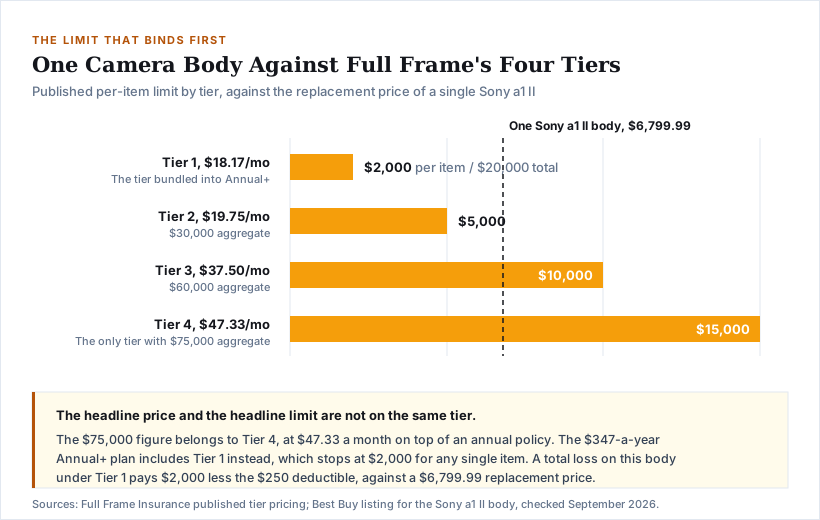
- $347 a year is Full Frame's Annual+ plan, and by their own page it includes Tier 1 equipment coverage: $2,000 per item, $20,000 aggregate.
- The $75,000 figure belongs to Tier 4, at $47.33 a month, roughly $568 a year, added on top of an annual policy rather than included in the $347.
- A Sony a1 II sells for $6,799.99 at Best Buy today. Under Tier 1, a total loss pays $2,000 less a $250 deductible.
- He was quoted about $2,150. Tier 1's per-item cap is $2,000. Those are two entirely different mechanisms landing within $150 of each other.
- Full Frame publishes its limits, its tiers, and its deductible. It does not publish its settlement basis anywhere we could find.
What Does $347 a Year Actually Buy at Full Frame?
An annual business policy plus the cheapest of four equipment tiers, not the top one. Full Frame's camera equipment page lists the tiers with prices attached:
- Tier 1: $2,000 per item, $20,000 aggregate, $18.17/month
- Tier 2: $5,000 per item, $30,000 aggregate, $19.75/month
- Tier 3: $10,000 per item, $60,000 aggregate, $37.50/month
- Tier 4: $15,000 per item, $75,000 aggregate, $47.33/month
The same page then says that "Annual Plus plans include the first tier of equipment coverage for a total policy cost of $30.17 per month," and prices Annual+ at $30.17 a month or $347 a year. So the $347 and the $75,000 are real numbers from a real price list. They just are not on the same line of it. Reaching the $75,000 aggregate means Tier 4, at about $568 a year, on top of an annual policy that their cost page starts at $129. Call it roughly $700 a year rather than $347.
This is not a hidden term. It is on the public pricing page, stated plainly, and Rob still read it the other way. That is worth sitting with, because he is clearly a careful shopper: he went back and edited his own post to add the limitations after further research. The page is arranged so the most attractive price and the most attractive limit are both prominent, and nothing in between them says they belong to different products.
Why the $2,150 Number Is Ambiguous
Because at least two separate mechanisms in this policy can cut a payout on an expensive body, and from outside they produce indistinguishable results.
Rob attributed his quote to a depreciation schedule, and he may well be right, since he says he inquired and that is presumably what he was told. But look at what Tier 1 does on its own. His a1 II lists at $6,799.99 at Best Buy as of this writing, reduced from $6,999.99. Under a $2,000 per-item cap, a total loss on that body pays $2,000 regardless of how new it is, minus the $250 deductible Full Frame applies to equipment claims. That is $1,750 against a $6,799.99 replacement price, a shortfall of about 74%, and depreciation never enters into it.
The distinction matters because the fix is different in each case:
- If the number is a per-item cap, the fix is buying a higher tier. Tier 4's $15,000 per-item limit clears a $6,800 body with room to spare, and the extra costs a few hundred dollars a year.
- If the number is a depreciation schedule, buying a higher tier does nothing. You would be raising a ceiling that was never the binding constraint, and the payout on a two-year-old body stays where the schedule puts it. The fix is a different carrier, or a scheduled policy with an agreed amount.
A photographer comparing quotes cannot tell which one he is facing, which means he cannot tell which fix to buy. This is the same asymmetry we walked through for Travelers' Valuable Items Plus, where a blanket limit and a per-item cap fail independently and the smaller one binds first. The difference is that Travelers publishes both numbers. Here, only one of the two is on the website.
Does Full Frame Publish How It Settles a Claim?
Not that we could find. We checked their camera equipment page, their main photography insurance page, and their cost and coverage post. None of them contains the phrase "actual cash value." None describes a depreciation schedule. The only appearance of "replacement cost" on the main policy page is in the section about drones.
What the equipment page does say, repeatedly, is that the coverage helps "cover the cost to repair or replace gear." That reads like replacement cost to anyone who is not an underwriter. And the cost page offers this piece of shopping advice:
"Make sure to choose limits that match your kit's real replacement value."
That sentence only makes sense under a replacement cost settlement. If the policy actually pays a depreciated value off an internal schedule, then matching your limits to replacement value means buying more limit than the policy will ever pay out on. We are not saying the advice is wrong, because we cannot see the policy form. We are saying that a customer following it cannot tell whether they are being helped or oversold, and Full Frame is the only party who can resolve that.
This is the same shape as the gap we found in PPA's PhotoCare terms, where the published deductibles and the deductibles one member actually paid were not the same set of numbers, and nothing on the public site let anyone check in advance. Published limits with an unpublished settlement basis is a recurring pattern in this corner of the market, and it is the single most useful thing to ask about before you buy.
The Unattended Exclusion Is Broader Than "In a Car"
Rob described limitation one as gear "left in car unattended." Full Frame's page states it more broadly than that:
"Mysterious disappearances are not covered. So, if your gear is left unattended or unsecured and it is stolen, it's not typically covered."
No vehicle required. That matters because of what Rob opened the thread asking about in the first place:
"I want to do timelapse photography and just let the camera do its thing for 2-3 hours … is sitting next to it and guarding really my only option?"
A three-hour unattended timelapse is the exact scenario this exclusion describes. He was shopping for coverage against a risk the policy specifically declines, and the sequencing of the thread means he probably would not have connected the two. One respondent got there without the policy in front of him, arguing that the shot should be planned around staying close:
"For a long timelapse, I would plan the shot around keeping the camera in sight rather than leaving it to fend for itself."
That is the honest answer, and it is not an insurance answer. Mysterious disappearance exclusions are close to universal in this class of policy, so shopping harder does not solve an unattended-gear problem. Location choice, a cable lock, and staying in sightline do.
Two Full Frame Pages Disagree About Rented Gear
They do, and it is worth knowing which one binds before you rely on either. The equipment page says the coverage applies to items "you own or rent and use for work." The FAQ on the cost page says the opposite:
"No. Standard camera equipment coverage applies to your own gear. Rented or borrowed equipment isn't covered."
One of those is wrong, or they are describing different products without saying so. If you rent bodies for jobs, or borrow a friend's lens, this is a question to get answered in writing rather than from either page. We covered what happens when borrowed gear breaks and nobody checked the policy first in our piece on lending camera gear to a friend, and the answer usually turns on exactly this kind of clause.
One More Thing Rob Ran Into: This Is a Business Policy
Full Frame's camera equipment coverage is an add-on to a small photography business policy, and it is not available on single-event policies at all. Rob does not sell photographs. Before he got to Full Frame he had already been turned away twice for the same reason, as he put it in the thread: State Farm told him $50,000 of equipment "would need to be setup as 'commercial'," and "Also looked at Hartford and they were another 'no thanks' company unless I was a 'business'."
That is a separate problem from the one this post is about, and it deserves its own treatment. The short version is that a serious hobbyist with a five-figure kit can find themselves squeezed out of personal-lines coverage by the value of the gear rather than by anything they do with it, which is the reverse of what most people expect. Our post on hobbyist coverage without a business covers the ground from the other direction.
A Correction to Our Own Earlier Posts
We have cited Full Frame's pricing in four published posts as a favourable comparison point: the $55 entry tier for gear coverage in our store protection plan piece, and roughly $300 a year in our premium increase piece. Those figures were accurate on price and incomplete on what the price buys. A $55 or $347 tier carries a $2,000 per-item limit, which is below the value of a single current flagship body and below plenty of individual lenses. We are leaving the original sentences in place and noting the limit here, because the prices were and are real. They are just not comparable to a policy that would pay out the full value of one camera.
The Two Questions to Ask Before You Buy
Ask both, and ask them about your single most expensive item rather than about your kit total.
- "Which tier is included at the price you just quoted me, and what is the per-item limit on it?" The aggregate is the number on the marketing page. The per-item limit is the number that decides a claim on one body, and it is the one most likely to be quoted at a different tier than the price.
- "Is this settled at replacement cost or actual cash value, and if it is actual cash value, can I see the depreciation schedule in writing before I buy?" A carrier that will not show you the schedule is telling you something. So is a carrier whose website advises you to match your limits to replacement value without saying that is what it pays.
Then do the arithmetic Rob effectively did by accident: take your most expensive body, subtract the deductible from the per-item limit, and compare that to what the body costs new today. If the gap is uncomfortable, the tier is wrong, the carrier is wrong, or both. For the difference between depreciated payouts and agreed amounts, and when the latter is worth paying for, see our piece on agreed value coverage for appreciating gear.
None of this makes Full Frame a bad policy. At $347 a year for a working photographer whose most valuable single item is under $2,000, it is priced sensibly and the limits are published honestly enough that a careful reader can find them. It makes it a policy that is easy to buy for the wrong reasons, which is a different criticism, and a more common one.
Compare what other providers actually cover in our provider comparison table, and see how we evaluate them in our methodology.
Related on GetCameraGuard
Is Travelers' Valuable Items Plus a Per-Item Limit or a Total? It's Both, and the Smaller One Binds First
Valuable Items Plus gives you a blanket limit you choose and a per-item cap you don't. The claim that gets cut short is almost always stopped by the number you never picked.
Read →
Your Camera Cost $400 in 2014. It's Worth $2,500 Now. Does Your Insurer Know That?
Film cameras are appreciating assets now, not depreciating gear. Most insurance is built for the opposite. A real thread about insuring a Contax T3 and a Hasselblad 500CM shows what happens when the two collide, and what actually fixes it.
Read →
PPA Says the Repair Deductible Is $50. One Member's Claim Came With Over $550 in Deductibles.
PPA publishes a $50 PhotoCare repair deductible. A member who filed reported over $550. You can't read the policy before paying $323 to check.
Read →
Adorama Protect and Canon CarePAK Cover Drops. They Don't Cover Theft, and That's the Whole Point
Two Reddit threads ask the same question in different words: is a retailer or manufacturer protection plan the same thing as camera insurance? Their own terms say no, in one specific line.
Read →