He Wanted E&O Without Losing His Gear Policy. Most Insurers Don't Let You Do Both.

A newer wedding photographer posted a careful, well-organized question to r/WeddingPhotography: five numbered items, no venting, just someone trying to get properly covered before booking more work. He already had a business policy through State Farm handling general liability and his equipment. The problem was a single missing product.
What makes his case worth reading is why he didn't want to leave. His State Farm equipment coverage, he wrote, "includes accidental damage, theft without evidence of forced entry, and mysterious disappearance. From what I've seen, many photography insurance policies either exclude those situations or require proof of forced entry before they will cover a theft claim." He is right, and that is not a small detail. We have documented what the forced-entry requirement does to a real claim: a photographer robbed at an Airbnb watched €5,000 evaporate because nobody could find signs of a break-in. Terms like his are worth protecting.
Then the catch: "The one thing State Farm doesn't offer, at least through my agent, is professional liability / Errors & Omissions coverage."
So he was stuck in a shape that turns out to be extremely common. The coverage he needed was not expensive or exotic. It was just not for sale where the rest of his insurance already lived.
The Claim That Isn't Injury and Isn't Breakage
General liability answers "someone got hurt." Equipment coverage answers "something broke." E&O answers the third question, the one that has nothing physical in it at all: the client is furious about the work. We laid out that three-way split in detail in our guide to liability coverage and certificates of insurance, so the short version is enough here. A corrupted card, a missed shot, an album three months late. Nobody bleeding, nothing broken, and no policy responding.
The more interesting version of that scenario came from the videography side. A corporate video producer moving from web work into TV commercials asked whether E&O was actually necessary, reasoning that his client approval process was strict enough that no bad detail could reach air without a signature on it. The best answer in the thread agreed with him about factual errors, then pointed somewhere he had not considered: the licensing chain.
"Say for example you use a piece of stock music, pay for it and get a suitable license from the provider in good faith. It transpires that, through negligence or error from the stock service you purchased the license from, they didn't actually have the necessary rights for that asset to be able to license it to you, and even though you've got a license in writing it's invalid." — smushkanFX9
The rights holder sues your client. Your client sues you. You did nothing wrong, you paid for the license, you have it in writing, and you are still the defendant. That commenter's practical read was that E&O is worth carrying mostly for this, not for content errors, because content accuracy can be pushed onto the client contractually before publication while a broken license chain cannot.
The original poster added two more from his own experience: a trademarked logo left un-blurred in a frame, and a production he heard about where a piece of talent had a non-compete with a different production company, and the resulting lawsuit pulled in the second production company along with it. In every one of these, the money at risk is legal fees on a claim you will probably win.
Why You Probably Can't Just Add It
Here is where both threads converge on the same wall. The videographer went to his broker and came back with this:
"I'm with one of the major insurance companies Intact Insurance, but for some reason they don't offer E&O for video production. When I talked to my broker, turns out the other insurance company that offers it will only do so as an add-on to general liability, so I have to switch my entire insurance over." — nimsty
His quote for adding it: about $2,000 a year, plus moving his whole program to a new carrier to get it.
That is the structural problem, and it is worth naming plainly. E&O is frequently sold as an attachment to general liability rather than as a product you can buy by itself. So the request "I would like to add professional liability" quietly becomes "I would like to replace my insurance," and any unusually good terms sitting in the policy you already have, exactly like the wedding photographer's mysterious-disappearance clause, are what you pay for the privilege.
One thing worth checking before anyone follows the videographer's path: Intact does publish Errors and Omissions coverage for producers through its entertainment specialty division, covering defamation, unauthorized use of names, invasion of privacy, piracy, copyright infringement, and breach of contract. That does not mean his broker was wrong about his own situation, since specialty entertainment programs have their own eligibility rules and are not written off the same desk as a standard commercial package. But it does mean "my insurer doesn't offer it" sometimes really means "the division writing my policy doesn't offer it." Ask whether the carrier has a specialty or entertainment desk before you move everything.
Splitting Coverage Across Two Carriers
The wedding photographer's fifth question was the sharpest one he asked, and the thread mostly skipped it: has anyone had problems carrying general liability and equipment with one company and E&O through another?
The one commenter who engaged with it was reassuring:
"It's pretty common to split coverage between companies. Plenty of photographers keep their gear/GL with one insurer and buy standalone E&O elsewhere. PPA, Full Frame, and Hiscox come up a lot. I'd compare what's actually covered (lost images, missed moments, failure to deliver), not just the premium. A cheap policy isn't much help if it excludes the claims you're most worried about." — Ok-Procedure8921
That is correct, and there are two costs worth knowing about anyway. The first is money: bundling discounts are real but small. Hiscox, for example, advertises up to 5% for buying two or more products, which is not enough to force a decision.
The second is the one that actually bites. Some claims are physically and professionally the same event. A memory card fails at a wedding. That is an equipment problem and a failure-to-deliver problem in the same breath, and with a split program it lands on two carriers who each have a reason to point at the other. Nothing about that is unfixable, but it is a conversation to have with both agents while you are shopping, not after a card dies. Ask each of them directly how they handle a loss that triggers the other policy.
The Price Spread Is Enormous, and It Isn't Arbitrary
Advice threads talk about E&O as if it has a price. It has a range, and the range is roughly twentyfold.
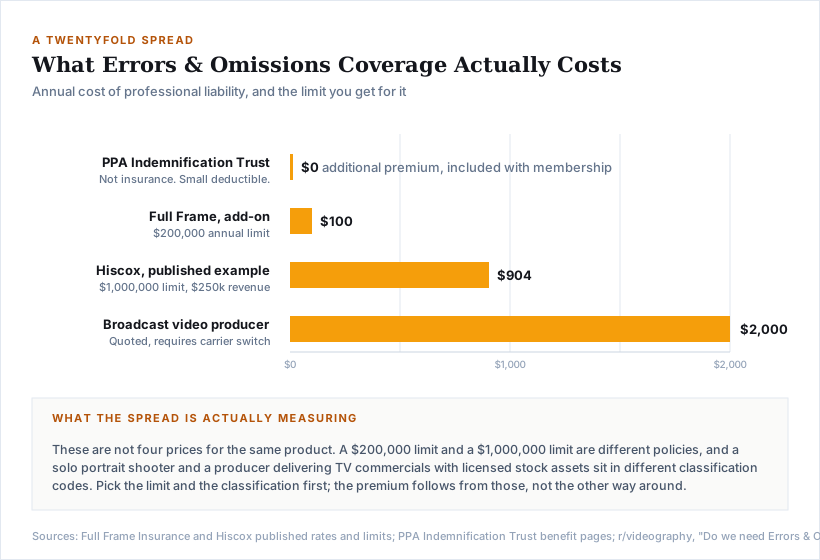
At the low end, Full Frame Insurance sells professional liability as an add-on for $100 a year, paying "up to $200,000 per year for covered professional liability claims." Their page is also refreshingly blunt about what it is not, listing "stolen or broken cameras or gear" among the things this coverage explicitly does not touch. It is a service-dispute policy, full stop.
In the middle, Hiscox publishes a worked example: a photographer in Kansas City with $250,000 in annual revenue paying $75.30 a month, about $904 a year, for professional liability at a $1,000,000 annual limit.
At the top is the videographer's $2,000. The gap between him and the Kansas City example is not a markup, it is a different risk. He is delivering to broadcast, with licensed stock assets, talent agreements, and trademarks in frame. Commercial insurance is priced off classification codes that sort businesses by expected loss, the same machinery we saw drop a wildlife photographer for shooting "risky" subjects. A solo portrait shooter and a TV commercial producer are not in the same bucket, and the premium is where that shows up.
Which means the useful question is not "what does E&O cost." It is "what limit do I need, and what work am I being classified for."
PPA's Version Isn't Insurance, and That's the Point
PPA came up in the thread, and its offering deserves its own note because it is structurally different from everything above. The Indemnification Trust is included with membership rather than sold as a policy. PPA describes it as covering the situation where "memory cards fail. Shots are missed. Clients decide it's your fault clouds blocked the sunset on their special day."
What the Trust will actually do, in PPA's own list, is guide you through filing, pay for data recovery, negotiate and pay a settlement, prepare you for court, appoint local counsel at the Trust's expense, and pay judgments for most types of damages awarded to your client. PPA's summary: it "covers and protects all PPA members at no cost after they clear a small deductible."
The genuinely interesting consequence is that because it is a trust and not an insurance policy, using it does not generate the rate consequence a claim normally would. That is a real advantage in a market where, as we found, photographers are watching premiums climb 50 to 137% without ever filing anything.
The tradeoff is the flip side of the same fact. A trust operates on its own terms rather than a policy contract with defined limits you can read in advance, and it applies to active members in the US and Canada. It also sits alongside PPA's equipment coverage, which, as we covered in detail, is secondary insurance rather than primary. Worth having, not automatically a substitute for a policy with a stated limit.
The International Footnote Nobody Explains
One short comment on the wedding thread deserves more attention than its two upvotes suggest:
"i use travelers.com - whoever you use make sure they cover you internationally if you travel at all, most don't" — iamthesam2
He is pointing at something that hides behind the word "worldwide." Hiscox markets worldwide coverage, and per NerdWallet's review of the carrier, its professional liability policies "cover work done anywhere in the world, as long as the claim is filed in Canada, the U.S. or its territories."
Read that twice, because it describes two different geographies. Where you shoot is unrestricted. Where you can be sued is not. Photograph a destination wedding in Italy and the coverage follows you; get sued in an Italian court by an Italian client and the policy may not respond at all. For anyone shooting destination work, that is the question to put to an agent in writing, and it is a different question from the one about gear coverage abroad.
What to Ask Before You Move Anything
The wedding photographer's instinct, keep the good policy and buy the missing piece separately, is the right starting position. Before you give it up:
- Ask whether E&O can be written standalone, or only as an attachment to that carrier's general liability. This single answer determines whether you are adding a policy or replacing your program.
- Ask whether your current carrier has a specialty desk. The entertainment or media division may write coverage the commercial-lines side does not.
- Price the terms you would be giving up. Accidental damage, theft without forced entry, and mysterious disappearance are not standard everywhere. Get them in writing on the replacement quote before you cancel anything.
- Pick the limit before you compare premiums. $200,000 and $1,000,000 are different products, and a cheaper number attached to a smaller limit is not a better deal.
- Ask both carriers how a split-claim event works when one loss triggers gear coverage and failure-to-deliver at once.
- Ask where a claim has to be brought, not just where you are covered to work, if any of your bookings are outside the country.
E&O is the rare coverage nobody demands from you. No venue asks to see it, no client requires it, and no certificate depends on it, which is exactly why it stays unbought until a licensing chain breaks or a card fails. The threads above are two people doing the unglamorous work of finding that out before it happens rather than after.
See our comparison table for how providers handle liability and equipment coverage for working photographers, or our full methodology for how we evaluate what a policy actually includes.